 Critique of Pure Slurp
One Year of Lifting: A Reflection
After lifting for a year, this is what I’ve learned.
Introduction
New lifters are relentlessly bombarded with the “right” and “wrong” ways to exercise:
- “Top 7 Exercises that Science Says You are Doing WRONG!!!!!”
- “The One (1) Form Mistake All Newbies Make that KILL YOUR GAINS!!!!!!!!!”
- “Here are 4 Ways to get KILLER BICEPS PEAKS AND H-CUP PECS!!!???????????”
- How to grow your forearm veins until they are the circumference of penne pasta (The establishment doesn;t want you to know this?!!!!!!!!!!)
- Other statements dreamed up by the utterly deranged
This tomfoolery is supported by:
- Appeals to authority: Some buff guys covered in baby oil said to do this so they must be correct because they are buff.
- Appeals to science: One research paper from 2009 said that () might be good for you, so () must be correct because it has been “proven” with “Science”.
- Appeals to nature: This exercise builds “functional strength” and it is a “natural movement” so it must be correct.
- Advertising: Be wary of anything that tries to sell you supplements. You do not need them to exercise. Also, take notice of the influencers you see wearing GymShark/YoungLA clothes. You do not need those either.
- Horrendous anatomical and physiological misunderstandings.
It is important to note that elements of truth can be found in all of these above fallacies (maybe the buff guy does know what he’s talking about!). Just know that it’s always a good policy to think critically about what you see.
Instead, focus your understanding on three open-ended principles:
- Metaexercise
- Exercise Overview/Selection
- Diet + Recovery
Part 1: Metaexercise - The Nature Behind Exercise
The most important question that any prospective or current exerciser should ask themselves is: “Why do I want to exercise?”
The primary reason we fail to achieve success is because our motivations are wrong. Do not exercise because you feel inferior to others and yourself, or because you want to feel superior to others and past versions of yourself. That isn’t the point. If you are unable to find this motivation, that is fine. There are other aims in life, and you can take comfort in closing this article. However, if you do not wish to strive in any regard whatsoever, then can you truly call yourself alive?
The best motivation is intrinsic. You should exercise because you want to benefit yourself, and because you want the capability to help others. With these motivations in mind, you are now able to move on to the nerdy stuff.
Part 2a: Exercise Overview
Behold this flowchart that I made on my whiteboard in five minutes (but how long did it take to format on this goddamn site?):
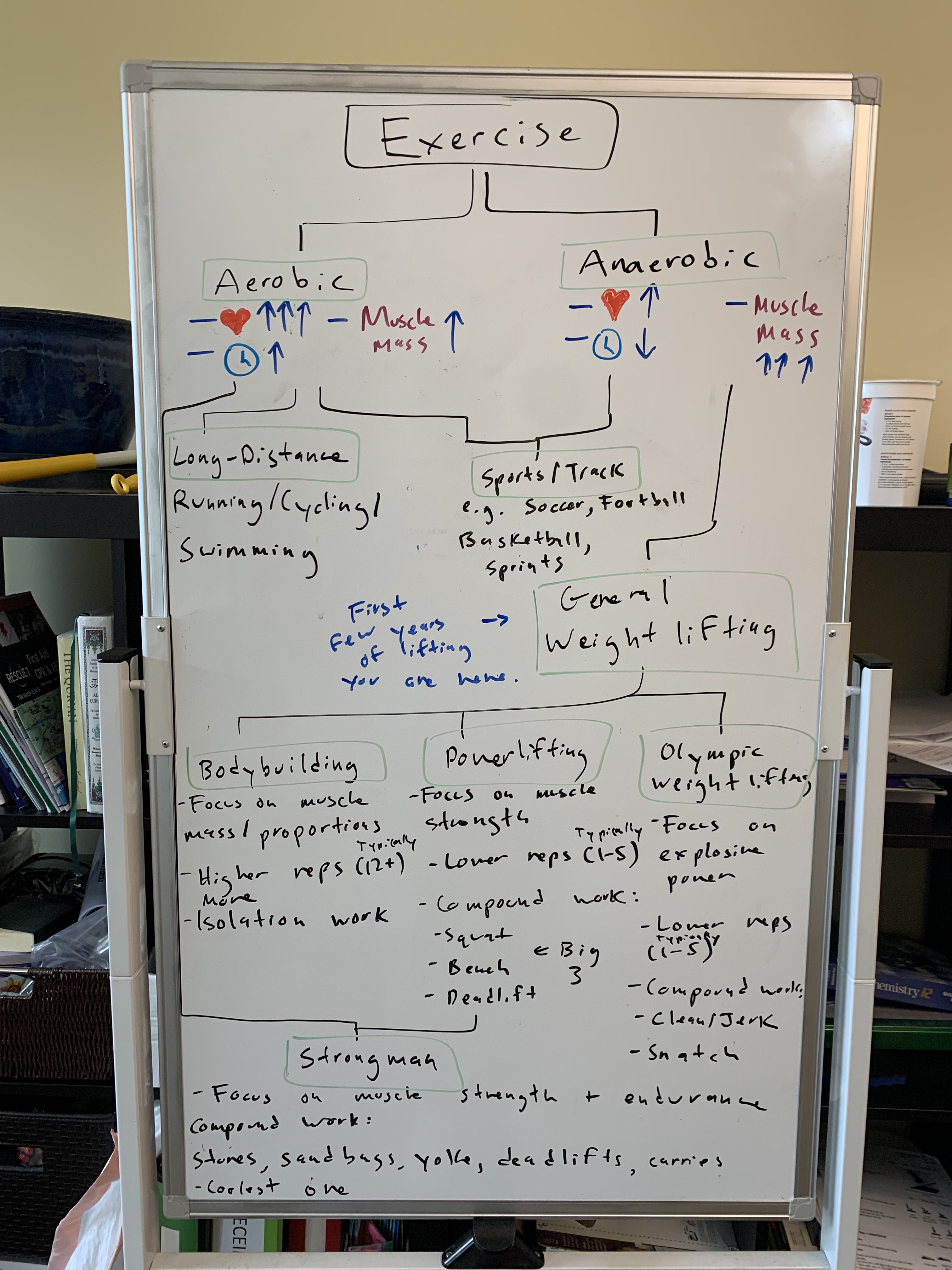
Exercise can be thought of as aerobic or anaerobic depending on the energy system your body uses to perform the exercise. Exercises performed for longer durations of time with less bursts of power (think long-distance, long-time) rely on the aerobic system and primarily stress the cardiovascular system (heart + lungs). Exercises performed for shorter durations of time with maximal bursts of energy (think high-powered sprints or lifts for short amounts of time) rely on the anaerobic system and primarily stress muscles and the neurological system.
A common misconception is not understanding the goals and results of a training modality. If you run or bike for long distances, do not expect to gain considerable muscle mass. If you train like a bodybuilder, do not be surprised if a powerlifter can lift more weight than you. This is a common misconception that muscular size is a perfect 1:1 correspondence with muscular strength. In reality, the specific training methods of each form of exercise lead to differing outcomes. Who would have thought?
Part 2b: Exercise Selection for General Weightlifters
Know the main muscles in your damn body so that you can effectively pick movements that target the whole body. You don’t need to be a walking textbook of Latin names ummm acctually u should sayLong head of Biceps brachii because if you just say biceps you could be referring to the Long head of the biceps femoris As well, know the functions of each muscle. Movements can be:
- Compound: Works more muscles at once (Typically has primary muscles worked and secondary muscles worked)
- Isolation: Focuses on one muscle
Movements can be performed for:
- Low reps (sets of approximately 1-5): Typically done with maximal-strength movements like the deadlift.
- Medium reps (sets of approximately 6-11): Can be done for most movements
- High reps (sets of approximately 12+): Typically done with isolation movements or compound movements for the purpose of targeting the cardiovascular system.
Movements can be done with the following equipment:
- Bodyweight
- Free weights
- Barbells
- Machines
Your pectoral muscles cannot tell the different between 500 W of power applied via pushup, bench press, dumbbell press, or machine press. Just try them out and see what you like. This debate on the method of exercise is infuriating (“omg!!! if you do calisthenics your physique is better because it is natural” <- nerd).
Also, here are some common exercise splits. Consider how many days and how much time you have. Make the schedule work for you; don’t work to adjust to the schedule.
- Push(Chest)/Pull(Chest)/Legs
- Upper/Lower
- Full-body
For a time-pressed lifter like I am during school years, I suggest focusing on five key compound movements in no particular order:
- Deadlift (Hip flexion + knee flexion)
- Targets upper, mid, and lower back, hams, glutes, abs, hip flexors, and forearms
- Variations include: Conventional deadlift, sumo deadlift, deficit deadlift, rack pull, Romanian deadlift, stiff-legged deadlift, wide-grip deadlift, axle-bar deadlift, trap bar deadlift, strongman front carries, kettlebell swings, Good Mornings, hip thrusts
- Squat (Knee flexion + hip flexion)
- Targets quads, hams, glutes, lower back, abs, calves, hip flexors, and adductors
- Variations include: High-bar squat, Low-bar squat, front squat, wide/narrow stance squat, Bulgarian split squat, lunge, paused squat, pin squat, bodyweight squat, leg press, hack squat, pendulum squat
- Horizontal press (Pushing)
- Targets chest, triceps, front delt, lats, serratus
- Variations include: Bench press, dumbbell press, incline/decline presses, machine presses, cable flies, pushups, dips
- Vertical press (Pushing)
- Targets front/side delt, upper chest, triceps, lats
- Variations include: Barbell overhead press, dumbbell overhead press, machine press, handstand pushups
- Row (Pulling) -Targets upper, mid, and lower back, biceps -Variations include: Pullup, chinup, lat pulldown, facepull, barbell row, Pendlay row, single-arm dumbbell row, T-bar row, seated cable row
All of these movements have a range of acceptable techniques that vary from person to person, and variations can focus on each part of the main movement. You can supplement these movements with isolation exercises. This is an open-ended process, and you must try different exercises, splits, and rep schemes to find what works for you. If there was a one-size-fits-all routine, everyone would be doing it by now.
For example, say you have 2 days available to workout every week, with 1 hour for each workout. You can choose an upper/lower split. On the first day, pick 1 horizontal press movement, 1 vertical press movement, and 1 row movement. Then, pick an isolation movement that uses the same muscles (e.g. bench press, machine overhead press, assisted pullup, bicep curls). On the second day, pick 1 deadlift-type movement and 1 squat-type movement. Then, pick an isolation movement that uses the same muscles (e.g. conventional deadlift, leg press, leg curls, calf raises). The reps you do depend on your time and speed. Now you see why it is important to understand what muscles you are trying to work. Have a clear plan! Don’t hop around trying every machine, or pick a new Youtube workout every 4 days to waste 12 minutes on.
My current split is a 5-day split with no rest. Each day, I focus on 1 of those movement patterns.
Part 3: Diet/Recovery
- “Do you want a six-pack? Then do crunches!”
- “ I was afraid of getting too big but my personal trainer Brayden made sure I stayed toned!”
The above statements are so crazy that they are brazy. They rely on misconceptions surrounding diet, so I suggest they are remedied quickly so time is not wasted doing unhelpful, goofy exercises in an effort to “get shredded for the summer”.
All diet should be measured on a calories in/calories out basis. To gain muscle, you need to eat more calories than you burn (caloric surplus). To gain visibility of muscle striations (i.e. six-pack/toned/lean muscles), you need to burn more calories than what you eat while ensuring you train enough so you lose minimal muscle (caloric deficit).
You cannot target fat loss in a specific area of the body by doing exercises in that region. That is possibly the most devious misconception about exercise, where malicious entities prey off of bodily insecurities to sell snake oil programs (Want bigger biceps peaks? Do this exercise? Want abs? Do this 6-minute ab routine (biceps peaks are controlled by genetics of muscle bellies vs. tendinous muscle and as I just said, you cannot target fat loss to a specific area, you can only have systemic fat loss )) and supplements.
Finally, your muscles recover and rebuild while you sleep. Sleep for gains!
Conclusion
Find intrinsic motivation to lift.
Use your brain when you exercise.
Don’t get lost trying to recreate Plato’s Ideal Form of a deadlift hinge pattern.
Eat enough and sleep more.